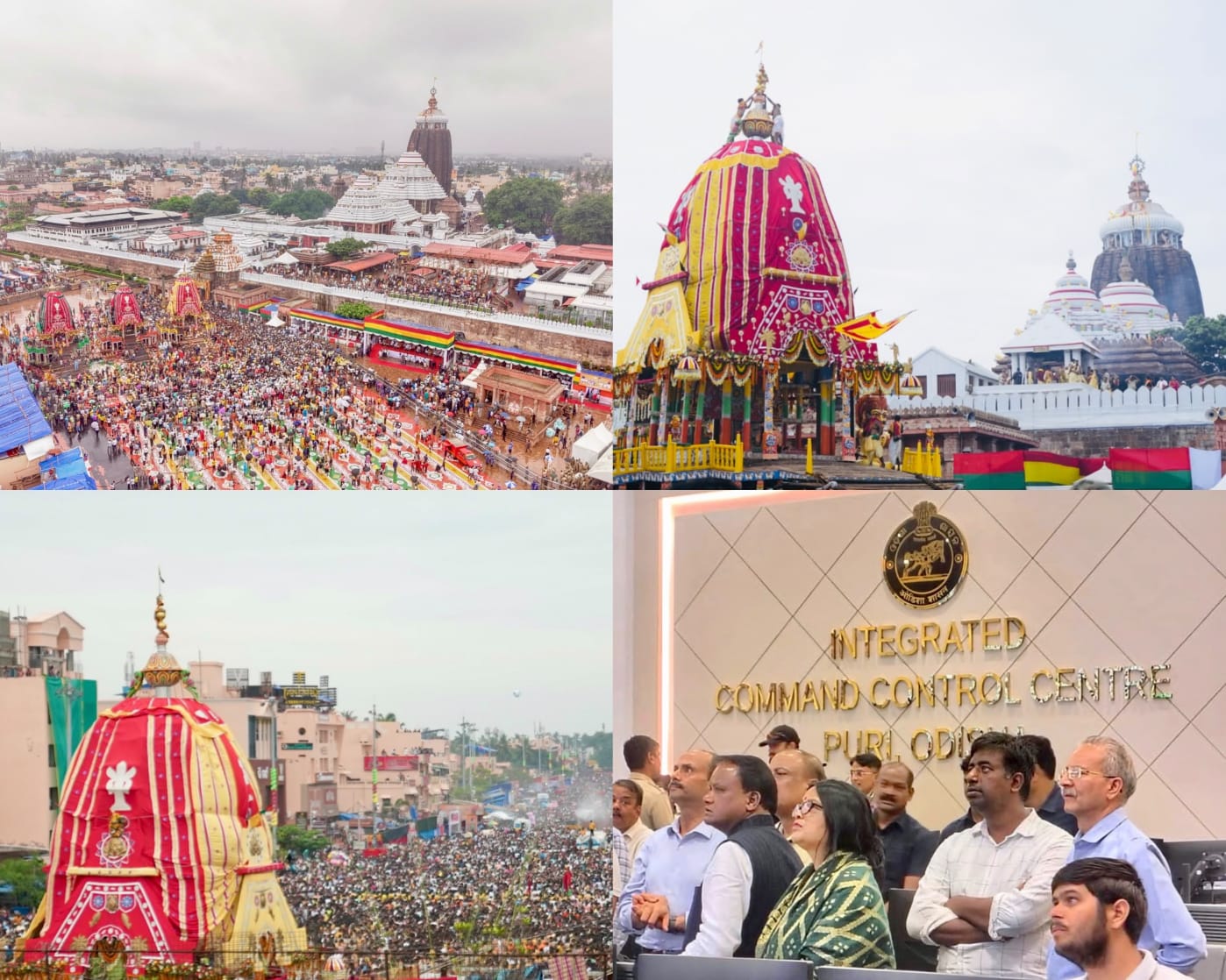
PURI, Odisha, India: As millions of devotees gathered around the chariots of Mahaprabhu Shree Jagannath, Lord Balabhadra and Devi Subhadra during Ratha Yatra 2026, another story unfolded largely beyond public view — one of an entire city being reorganised, monitored and sustained almost around the clock in service of the pilgrims who had come for Jagannath.
Over nine days, more than 5 million pilgrims passed through Puri, turning the coastal city into a temporary metropolis. Months of preparation preceded the festival, involving the Government of India led by Prime Minister Narendra Modi, the Odisha Government under Chief Minister Mohan Charan Majhi, and multiple agencies working towards a common objective: preserving the sanctity of the centuries-old Jagannath tradition while managing the extraordinary pressures of a modern mass gathering.
At the strategic and operational level, the Puri District Administration, led by Collector and District Magistrate Dibyajyoti Parida, became the coordinating hub for more than 25 departments covering policing, healthcare, transport, sanitation, water supply, engineering, fire services and civic infrastructure.
That coordination was further strengthened by experienced officers in key domains. Senior IPS officer Soumendra Priyadarshi, overseeing police arrangements, brought long experience in Rath Yatra policing and arrangements, while Arabinda Kumar Padhee, Chief Administrator of SJTA, contributed institutional coordination. Their experience provided an additional layer of support to the wider framework led by the Puri District Administration.
The numbers reveal the scale. Around 13,000 police personnel and 162 Executive Magistrates were positioned across critical locations. CCTV surveillance, control rooms, field communication and digital coordination helped officials monitor crowd movement, traffic and emerging pressure points, with decisions often translated into action within minutes.
Healthcare formed another critical layer. The city operated 15 temporary hospitals, 82 medical camps and 82 ambulances, supported by 326 doctors, 222 nurses and 173 paramedics. More than 63,000 people received medical attention, including assistance to over 19,000 elderly devotees.
Much of the festival was sustained by a workforce rarely seen in photographs. Around 1,600 sanitation workers, backed by 153 waste-collection vehicles, removed nearly 2,500 tonnes of waste. Electricians maintained lighting and temporary systems; engineers monitored roads and drainage; ambulance crews remained on alert; water-supply teams serviced kiosks and tankers; while firefighters, drivers, machine operators and volunteers worked through the night so that the city could be ready again before sunrise.
Heavy rainfall tested the system further. Dewatering operations using 38 municipal pumps and 37 Fire Service pumps across 42 vulnerable locations helped restore movement even as pilgrim flows continued.
Ratha Yatra 2026 was not the achievement of one institution. Odisha Police, DG, ADG, SP, Administrative Officers, Commissioner, SJTA, Puri Municipal Corporation, health teams, Fire and Emergency Services, Civil Defence personnel, volunteers and numerous government agencies and officers each carried distinct responsibilities. What held those moving parts together was sustained coordination on the ground.
For devotees, the enduring memory may be Mahaprabhu Jagannath, Balabhadra, Maa Subhadra, the chariots and the darshan.
For Puri, the untold story was what happened behind them: while millions prayed, the Puri District Administration stayed awake.